Add your promotional text...

IFTAK – Interception of Fistula Tract with Application of Ksharsutra
IFTAK (Interception of Fistula Tract with Application of Ksharsutra) is an advanced, targeted technique that combines sound anatomical understanding, modern surgical principles, and the time-tested efficacy of Ksharsutra therapy.
Dr. Arun Singh
1/1/20263 min read


A Targeted & Advanced Approach for Transsphincteric and Complex Fistula-in-Ano
Fistula-in-ano remains one of the most challenging anorectal diseases to treat, especially when the fistula is transsphincteric or complex. Conventional surgical procedures often involve extensive cutting of tissues, prolonged healing time, higher recurrence rates, and the risk of sphincter damage.
IFTAK (Interception of Fistula Tract with Application of Ksharsutra) is an advanced, targeted technique that combines sound anatomical understanding, modern surgical principles, and the time-tested efficacy of Ksharsutra therapy. This procedure is particularly effective in managing transsphincteric and complex fistulas with excellent outcomes.
Understanding the Root Cause of Fistula
It is now well established that all cryptoglandular fistulas originate from infection of the anal glands.
Anal glands are located in the intersphincteric plane
Infection of these glands leads to abscess formation
If untreated or inadequately drained, the abscess progresses into a fistulous tract
👉 Thus, the intersphincteric plane is the true root cause and key target in fistula management.
What is IFTAK?
IFTAK (Interception of Fistula Tract with Application of Ksharsutra) is a procedure where:
The fistulous tract is intercepted (divided) at the intersphincteric plane, the site of anal glands
This interception eliminates the primary source of infection
The distal tract (from interception point to external opening) heals spontaneously
The proximal tract (from interception point to internal opening) is ligated and treated with Ksharsutra
This focused approach avoids unnecessary cutting of long fistulous tracts.
Step-by-Step Concept of IFTAK Procedure
🔹 1. Identification of the Intersphincteric Plane
Accurate identification of the intersphincteric plane is crucial, as this is the origin of the disease.
🔹 2. Interception of the Fistula Tract
The fistula tract is intercepted at the intersphincteric plane, effectively disconnecting the distal tract from the source of infection.
🔹 3. Healing of Distal Tract
Once the source is removed, the distal tract heals automatically without any active intervention.
🔹 4. Ksharsutra Application to Proximal Tract
The remaining proximal tract—from intersphincteric plane to internal opening—is ligated with Ksharsutra and treated in the standard manner.
Role of Ksharsutra in IFTAK
Ksharsutra is a medicated thread described in Sushruta Samhita, known for its:
Gradual cutting action
Simultaneous healing
Antimicrobial and debriding properties
Minimal scarring
In IFTAK, Ksharsutra is applied only to a very short tract, making treatment more precise and efficient.
Why IFTAK is Ideal for Transsphincteric & Complex Fistula
✅ Avoids Long Cutting & Healing Process
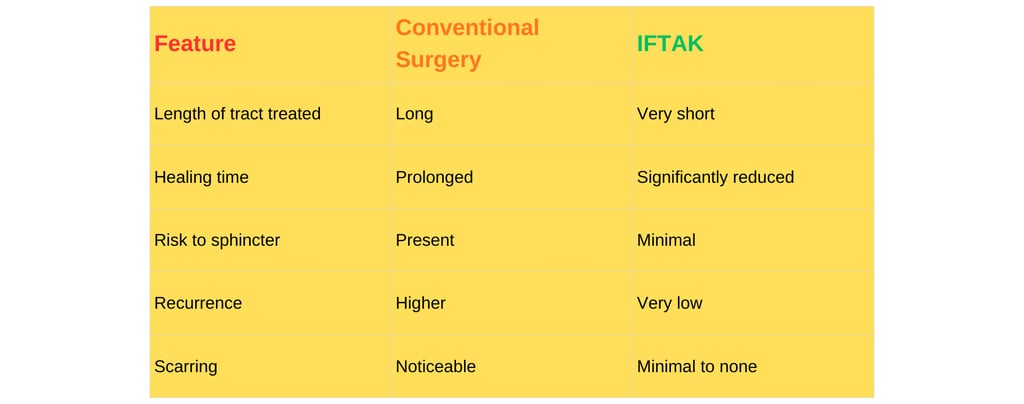
Traditional Ksharsutra treatment requires weeks to months for long tracts. IFTAK significantly reduces the length of tract under treatment, shortening overall duration.
✅ Preserves Sphincter Integrity
Since extensive cutting across sphincter muscles is avoided, the risk of incontinence is negligible.
✅ Faster Recovery & Minimal Scar
Because only a small segment of the tract is treated, healing is faster and almost scarless.
✅ Reduced Treatment Duration
Total treatment time is significantly reduced, improving patient compliance and comfort.
✅ Low Recurrence Rate
When performed correctly, IFTAK provides excellent long-term results.
IFTAK as a Modified LIFT Procedure
IFTAK can be considered a modified LIFT (Ligation of Intersphincteric Fistula Tract) procedure, with an important advantage:
LIFT alone relies only on ligation
IFTAK enhances the outcome by combining ligation with Ksharsutra application, ensuring controlled cutting, drainage, and healing
This hybrid approach makes IFTAK more reliable, especially in complex fistulas.
Success Rate and Recurrence
If the fistula tract is intercepted correctly at the intersphincteric plane, the success rate can approach near 100%
Incorrect identification or incomplete interception may lead to persistence or recurrence of the fistula
👉 Therefore, surgeon expertise and precise anatomical knowledge are critical for success.
Advantages of IFTAK Over Conventional Procedures
Conclusion
IFTAK – Interception of Fistula Tract with Application of Ksharsutra represents a refined and logical evolution in fistula-in-ano management. By addressing the root cause at the intersphincteric plane and combining it with the time-tested efficacy of Ksharsutra, this procedure offers:
Targeted treatment
Faster healing
Minimal complications
Excellent long-term results
For patients suffering from transsphincteric or complex fistulas, IFTAK stands out as a safe, effective, and sphincter-saving solution.